The Longevity Pyramid: A Lifestyle-Focused Framework for Healthy Ageing
Building the foundations of a longer, healthier life through the right balance of movement, recovery, nutrition and lifestyle.
The National Longevity Clinic
Originally written by The National Longevity Clinic
In the pursuit of longevity, the most valuable interventions are rarely the newest or most sophisticated. More often, they are the fundamentals, consistently practised and prioritised in the right order.
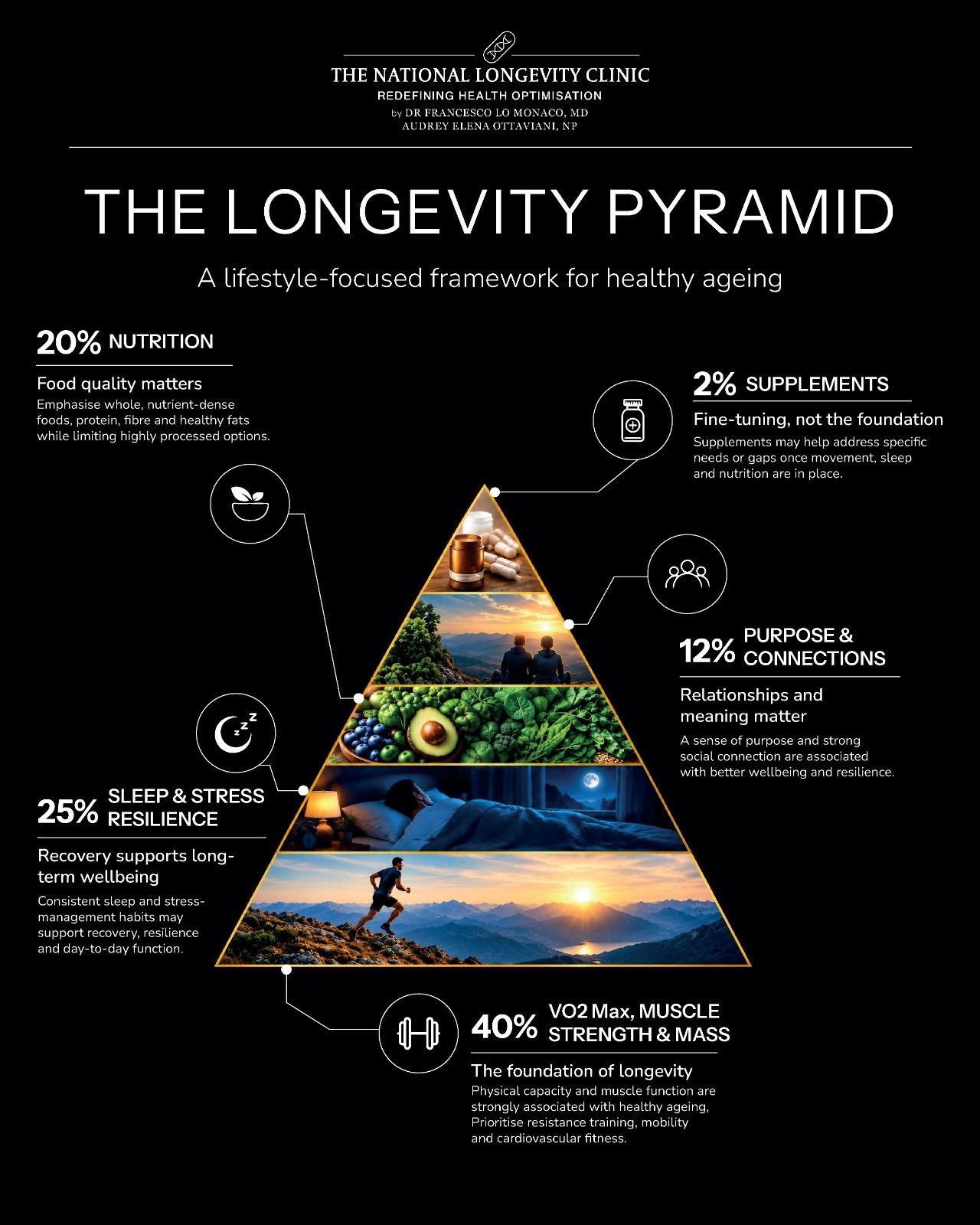
We approach healthy ageing through what we call The Longevity Pyramid — a lifestyle-focused framework that highlights the key areas of health that deserve our attention, from the foundations upwards.
The pyramid illustrates how we believe effort is best invested across five interconnected pillars: physical fitness, sleep and stress resilience, nutrition, purpose and social connection, and supplementation.
The percentages assigned to each pillar are illustrative rather than a scientifically validated formula. They represent our clinical philosophy on where attention and effort can have the greatest impact on long-term health.
1. Physical Fitness: VO₂ Max, Muscle Strength & Mass (40%)
The Foundation of Longevity
Physical capacity is one of the most important foundations of healthy ageing. Maintaining cardiovascular fitness, muscle strength and lean muscle mass supports not only physical independence, but also overall metabolic health and resilience as we grow older.
Research consistently highlights the relationship between physical fitness and long-term health outcomes.
In a study involving more than 120,000 adults, Mandsager et al. (2018), published in JAMA Network Open, found that higher cardiorespiratory fitness was associated with lower long-term mortality, with no observed upper limit to the benefits of improved fitness.
Similarly, research using UK Biobank data by Celis-Morales et al. (2018), published in The BMJ, associated greater grip strength with a lower risk of cardiovascular disease and mortality.
These findings reinforce the importance of building and maintaining physical capacity throughout life.
Key areas to prioritise include:
-
Regular cardiovascular exercise to improve VO₂ max and cardiorespiratory fitness.
-
Resistance training to preserve and build muscle strength and mass.
-
Mobility and functional movement to maintain physical independence.
-
Consistent physical activity as part of everyday life.
Physical fitness is not simply about performance. It is about preserving the capacity to live well for longer.
2. Sleep & Stress Resilience (25%)
Recovery Supports Long-Term Wellbeing
Exercise and nutrition often receive significant attention in health optimisation, but recovery is equally important.
Sleep is essential for the body’s restorative processes, while effective stress management helps support emotional, metabolic and physiological wellbeing.
Consistent, high-quality sleep allows the body to recover and adapt. Meanwhile, developing healthy responses to everyday stress can support resilience and overall quality of life.
Rather than viewing recovery as an occasional luxury, it should be treated as an essential part of a sustainable health strategy.
Key priorities include:
-
Maintaining a consistent sleep and wake schedule.
-
Prioritising sufficient, good-quality sleep.
-
Developing effective stress-management practices.
-
Allowing adequate recovery between periods of physical exertion.
A well-structured longevity programme should consider not only how much activity an individual performs, but also how effectively they recover.
3. Nutrition (20%)
Food Quality Matters
Nutrition plays a central role in supporting long-term health. Rather than following restrictive dietary trends or focusing on individual superfoods, the emphasis should be on overall food quality and nutritional adequacy.
A balanced, nutrient-dense diet provides the building blocks needed to support muscle maintenance, metabolic function and general wellbeing.
Our nutritional approach prioritises:
-
Whole, minimally processed foods.
-
Adequate protein to support muscle maintenance and recovery.
-
Fibre-rich foods to support digestive and metabolic health.
-
Healthy fats as part of a balanced dietary pattern.
-
A variety of vegetables, fruits and other nutrient-dense ingredients.
Equally important is limiting the excessive consumption of highly processed foods.
The objective is not dietary perfection, but consistency. Sustainable nutritional habits are far more valuable than short-term dietary interventions that are difficult to maintain.
4. Purpose & Social Connections (12%)
Relationships and Meaning Matter
Longevity is not measured by lifespan alone. The quality of those years matters just as much.
A growing body of research has highlighted the importance of social relationships, meaningful engagement and a sense of purpose in overall wellbeing.
Strong social connections can provide emotional support, encourage healthier behaviours and contribute to psychological resilience. Having a sense of meaning and direction can also positively influence how individuals experience and navigate different stages of life.
Despite their importance, these factors are often overlooked in conventional health and fitness programmes.
Supporting long-term wellbeing means making space for:
-
Meaningful relationships with family and friends.
-
Regular social interaction and community involvement.
-
Activities that create a sense of purpose.
-
Personal interests, hobbies and lifelong learning.
A healthier life is not simply about optimising biological markers. It is also about maintaining the connections and experiences that make life meaningful.
5. Supplements (2%)
Fine-Tuning, Not the Foundation
Supplements can play a useful role in an individual’s health strategy, but they should never replace the fundamentals.
While certain supplements may help address specific nutritional deficiencies or identified health needs, their value depends on individual circumstances, dietary intake, health status and clinical assessment.
We view supplementation as a targeted approach rather than a universal solution. The priority should always be to establish a strong foundation through physical activity, adequate sleep, stress management and balanced nutrition before considering additional supplementation.
Where appropriate, supplementation should be guided by individual needs, relevant investigations and clinical oversight.
The goal is not to take more supplements, but to make informed decisions about what the body actually needs.
A More Personalised Approach to Longevity
The Longevity Pyramid reflects a simple but important principle: healthy ageing starts with the foundations, not the latest intervention.
This philosophy informs how we design our programmes. Every individual has different health priorities, physiological characteristics and lifestyle demands. For this reason, assessment comes before recommendation.
Our approach may include a comprehensive review of:
Body Composition: Understanding muscle mass, body fat and overall body composition.
Cardiorespiratory Fitness: Assessing cardiovascular capacity and VO₂ max.
Muscle Strength: Evaluating physical strength and functional capacity.
Sleep & Lifestyle: Reviewing sleep quality, stress levels and daily habits.
Biomarkers: Assessing relevant health indicators to better understand individual health needs.
These assessments help establish a clearer picture of an individual’s current health status and identify areas that may benefit from targeted intervention.
Under clinical oversight, recommendations are then tailored to the individual’s needs, with the aim of supporting sustainable improvements in health and long-term wellbeing.
Building a Healthier Future Starts with the Fundamentals
The foundations of a long, healthy life are rarely glamorous. They are built through consistent movement, quality sleep, balanced nutrition, meaningful relationships and informed health decisions.
Longevity is not about pursuing every new trend or intervention. It is about understanding what matters, prioritising it appropriately and making sustainable choices over time.
Because a longer life is only meaningful when it is accompanied by better health, greater resilience and a better quality of life.
The National Longevity Clinic
Redefining Health Optimisation